Here to elevate the next generation of EMTs
Diana Lawler, a retired law enforcement officer, was a student in NWTC’s first EMT class. Now, 35 years later, she is helping prepare aspiring public safety professionals to protect and serve.
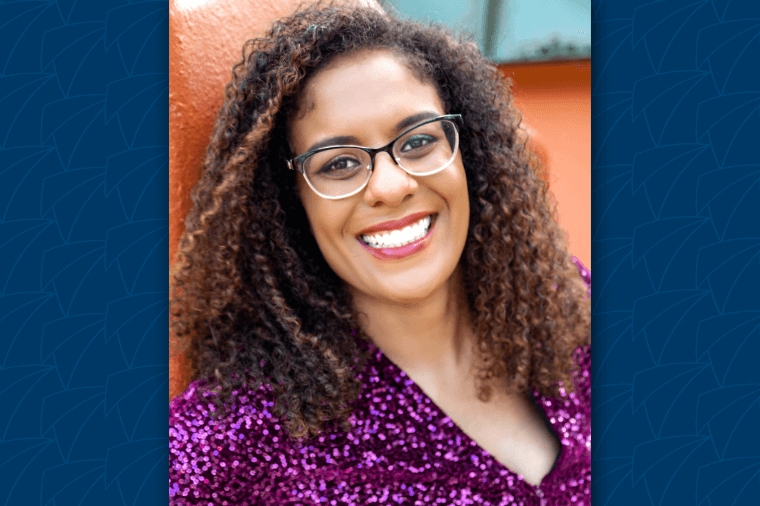
Some leaders draw strength from where they’ve been and use that wisdom to lift others as they move forward. At NWTC, Christine Bekyir, executive assistant to the vice president of Talent and Culture, is one of those leaders — someone whose lived experience, resilience, and commitment to community shape the way she shows up every day.
Bekyir’s connection to NWTC began in 2003, when she enrolled in the Paralegal program. As a young mother balancing classes and caregiving, she discovered strength through the support of faculty and staff who became her NWTC family. During this time, with the guidance of her mentor and academic advisor, Dr. Annie C. Jones, she also co-founded the African American Student Association, creating space she knew students like her needed.
After graduating in 2006, Bekyir built her career navigating corporate America as a Black woman before earning her bachelor’s degree in Democracy and Justice Studies from UW–Green Bay in 2014. Her dedication to community runs deep, reflected in her work with the Brown County Martin Luther King Jr. Community Celebration, Lovin’ the Skin I’m In, and other local organizations. In 2025, she was recognized as a Future 15 finalist for her positive impact across Greater Green Bay.
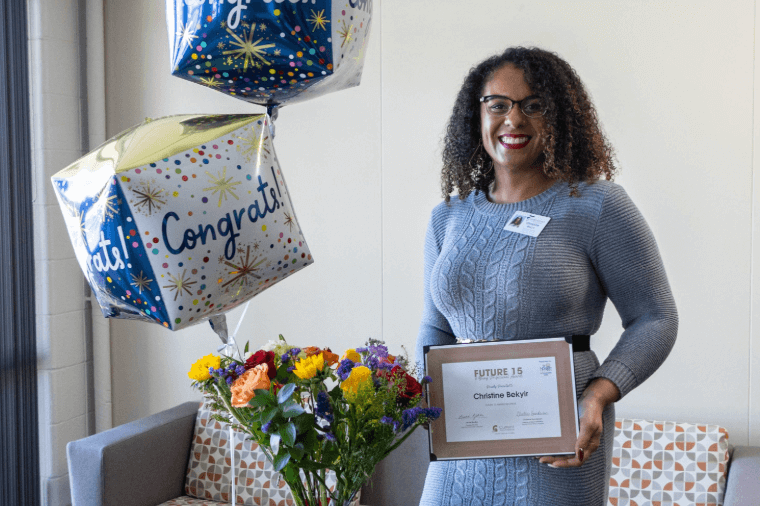
In 2025, Christine Bekyir was surprised at work when she was recognized as a Future 15 finalist by the Greater Green Bay Chamber.
As NWTC recognizes Black History Month, Bekyir’s story offers a meaningful lens into leadership, belonging, and what it means to uplift others. In the Q&A below, she reflects on the experiences that shaped her — and how she uses them to support and empower our campus community today.
When you reflect on your personal journey through education and leadership as an African American woman — what moments of affirmation or growth stayed with you — and how do those experiences shape the way you show up for others today?
As I reflect on my journey through education and leadership, I clearly see how being an African American woman shaped both how I learn and how I lead. Early in my career as a paralegal, I supported an attorney in a C-suite environment who trusted me to take ownership of processes, identify gaps, and develop improvements that made a real impact. She steadily expanded my responsibilities — including having me represent her during pre‑trial conferences.
A moment of affirmation that stays with me was when an opposing counsel refused to speak with me and demanded to speak directly with my attorney. My attorney called me into her office, put the opposing counsel on speakerphone, and said, “I’m going to have my paralegal answer your questions because she’s the most knowledgeable about the status of this case. If you want your questions answered, you’ll need to listen to her.”
That moment changed how I saw myself. Her confidence affirmed that my leadership and expertise were not only valid but essential. Where I once doubted myself, I began showing up with assurance, knowing I brought real value.
Today, those lessons guide how I lead at NWTC. I still work in a C-suite space, now supporting highly accomplished executives, but I show up with both confidence and humility — comfortable contributing ideas and honest about what falls outside my scope. I pay forward what was given to me by intentionally uplifting others through mentorship in our community lounges and through leadership in our Employee Involvement Groups.
Much of your leadership is rooted in community. How do those experiences influence the way you show up and lead in your role at NWTC?
My leadership is deeply rooted in the communities I belong to, and that shows up in how I advocate at tables where I’m often “the First, the Few, or the Only.” While I’m careful not to speak for any of my intersectional identities, I make sure the challenges, needs, and values of those communities are considered when decisions are made.
I know one of my strengths is influence, and I use that intentionally in my role as an executive assistant. A recent example is how the menu for the Brown County MLK Community Celebration evolved to better reflect culturally responsive food choices. Because I’m active in our local Black community, people felt comfortable sharing candid feedback with me — feedback they may not have offered in past years. I gathered those insights, worked with our chef to create a new menu, and brought the proposal to the MLK Celebration Committee, where it received resounding support.
You mentioned the Brown County MLK Community Celebration, an event you now lead as chair of the Celebration Committee. Can you take us back to the first time you attended this celebration? What responsibility do you feel in helping carry this celebration forward?
The first time I attended the Brown County MLK Celebration I was a student in NWTC’s Paralegal program and a work-study student supporting the Financial Aid Department. I brought my eldest daughter, Safiya, who was 1 year old at the time. Green Bay Press Gazette captured a photo of my mom holding Safiya during the program and placed it in the newspaper.
At the time, everyone in my NWTC village of support clipped the story for me and shared it. It was heartening to see how proud they were of that moment because my family is a living representation of Dr. King’s dream of achieving greater inclusion and equity for all.
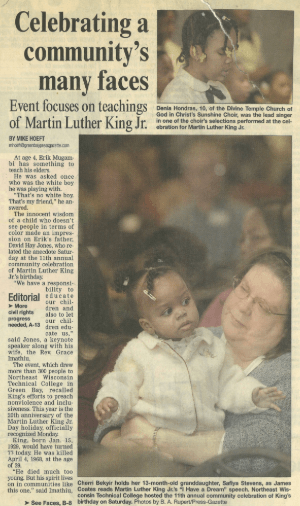
Christine Bekyir saved this newspaper clipping from the Green Bay Press Gazette where her mother is holding 1-year-old Safiya, Bekyir’s first child. The article in the clipping is about the 2006 Brown County MLK Community Celebration, which Bekyir now leads.
Stepping into the role of chair for the Celebration Committee felt like a full‑circle moment. I represent a new generation of leadership, and with that comes the responsibility to honor the longstanding work of those who built this event while also advocating for programming that reflects the moment we’re living in. I’m especially committed to engaging our youth and helping them connect the historical significance of Dr. King and the Civil Rights Movement to their current lived experiences.
In your experience, what makes someone feel like they truly belong — beyond statements, events, or initiatives?
As a UW-Green Bay Democracy and Justice Studies alumna, I’ve spent a lot of time studying social movements and belonging frameworks. I often return to UC‑Berkeley’s Othering and Belonging Institute, which defines belonging as ensuring everyone has the right to contribute to the political, social, and cultural systems that shape their world.
With that as my foundation, I believe true belonging happens when people are included, have agency, and can influence the decisions that affect them. It’s also about feeling seen, valued, and connected to the community.
For me at NWTC, belonging looks like being able to show up as my authentic self. I wear culturally representative, colorful clothing, my hair is big and natural, I use African American Vernacular English (AAVE), and I advocate for decisions and programming through the lens of my lived experience as a Black woman grounded in equity.
Often, organizations uphold standards that reflect the dominant culture. That is why I show up the way I do on campus. I feel that it is important for students who look like me to see that they can have a successful career while staying true to who they are.
When conversations about diversity become louder or more challenging, what helps you stay grounded in the work itself?
I stay grounded in my work as a diversity practitioner by remembering that the data consistently shows support for my work.
The data reveals that institutions, organizations, and communities that embed inclusive practices into their culture report higher retention and organizational health, expanded access to growth and development of their community members, and better functioning organizations.
If a student today is standing where you once stood — unsure, navigating systems, leaning on the encouragement of others — what would you want them to know?
I would want that student to know that they are not behind — they are becoming. The beauty of becoming is that you get to remain a learner of life’s lessons. As a learner, you do not need every piece of your future mapped out perfectly to achieve the greatest vision you have for your future self. Anchor into your “north star,” or that vision of your future, and ask your community to help you on your journey.
When I was in that place of uncertainty — trying to finish my degrees, navigate parenthood, and build a career — I often felt like everyone else had life figured out. What I’ve learned since is that no one truly has it all together; we’re all figuring things out as we go.
Some peers may seem “ahead” because they have more resources, connections, or fewer barriers. But those of us who’ve had to navigate complex systems and uncertainty develop a different kind of strength. That resilience is a real asset — and it’s something you can lean on and leverage as you move forward.
Diana Lawler, a retired law enforcement officer, was a student in NWTC’s first EMT class. Now, 35 years later, she is helping prepare aspiring public safety professionals to protect and serve.
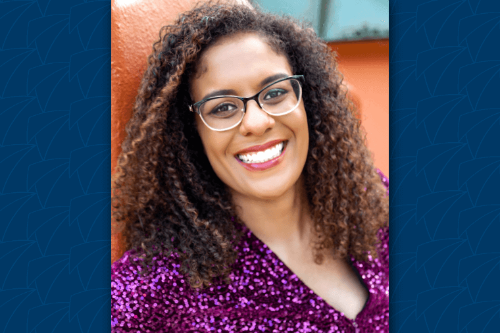
Christine Bekyir reflects on the moments, mentors, and communities that shaped her path in this Q&A honoring Black History Month.
Matt Kaczmarek, project manager/estimator and servant leader in his community, finds purpose in every project.