
Transfer graduate spotlight: Karlie DeGrave
After graduating from NWTC in 2024, Karlie DeGrave went on to earn her bachelor's from Lakeland University: “Transferring gave me the opportunity to open more doors."
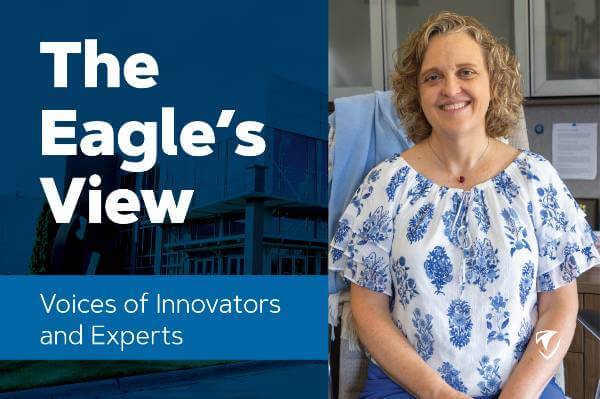
It’s mid-August at Northeast Wisconsin Technical College, and the Green Bay campus is humming with the energy of a new academic year. Dr. Jennifer Flatt stands at a Student Center entrance with fellow staff, ready to greet students, walk them to classrooms, and talk to them about their upcoming day filled with class, work, and family commitments.
Flatt loves building up the students of all ages and backgrounds and watching her colleagues do the same.
“Every student who walks in or logs into an online class is nervous because they want to be successful,” she says. “They believe embarking on this educational journey will change their lives for the better. We believe that too.”
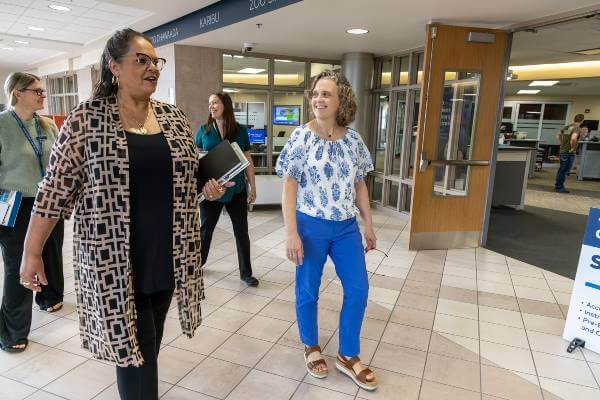
Flatt says there’s a nervous energy in any school at the start of an academic year. “We are nervous because what we are about to embark upon is incredibly important. There’s something transformative right beyond those nerves. Our job as educators is to take their nerves and turn them into optimism, hope, and drive. Then our job is to challenge them to grow, all while showing them consistent support and pointing them to the resources they are afraid to ask for on their own.”
Helping more students, many of whom don’t see college as an option for themselves, find their path toward a high-wage, rewarding career is a major focus for Flatt, who was appointed NWTC provost last March.
As provost, a newly-created position at the College, Flatt serves as chief academic officer and executive vice president of Academic and Student Affairs. She is leading the College’s efforts to integrate the two divisions, with the goal of building a seamless experience for students for their success.
“NWTC has been an outstanding college for decades, serving thousands of students at levels that many colleges would envy,” she says. “To be sustainable for the future and to take ourselves to the next level, to be the most effective possible, we need to zero in on the work that will have the greatest impact.”
Flatt recently talked about the evolution of higher education, the College’s new academic plan, and the promising impact of the provost model. This interview has been edited and condensed.
What changes in higher education excite or challenge you the most?
The evolution of technologies excites and challenges us in education as it does in every sector. I get to watch talented faculty learn how to integrate AI and other technologies meaningfully into both what they teach and how they teach it. I get to hear from students about the creative ways they use AI to study and learn. I get to hear from business and industry how AI and other technologies are transforming healthcare, manufacturing, marketing, and basically every field.
Faculty and students are certainly challenged by generative AI in the sense that we all have to decide what’s ok and what isn’t. Teaching ethical use of AI is essential and challenging, but educators love to learn, too; they are up to the task of learning to teach something new!
How do today's students learn differently than they did 10 years ago?
They continue to learn whenever they can – fitting learning and classes into busy lives with family commitments and work responsibilities, but 10 years ago it was harder for them to learn wherever they wanted. Now students can access tutoring support anywhere. They can take a summary and have AI create a podcast they can listen to as they go from home to work. They can do a discussion board on their phone on a break at work. Being that creative and flexible is great on the one hand because they can get their studying done, but the need to be that flexible is driven by the hectic and stressful lives students have.
How should colleges evolve alongside employers and communities?
Colleges need to evolve with employers and communities, in constant communication about needs and ideas. That happens best when we have intentional and longstanding relationships with partners across all sectors of our communities.
At NWTC, all our academic programs have advisory committees made up of employers who help guide how our programs need to evolve to match business and industry. Our corporate training account executives are in constant dialogue with employers, which allows us to train thousands of current workers each year. In our rural areas, our community impact coordinators are out at chamber meetings, connecting with businesses, and attending events – both to hear from them and to share NWTC news.
We have deep partnerships with key nonprofits across all our communities. For example, in Brown County United Way we have a strategic anchor partner, one who we meet with regularly, setting goals together, working together to help students find a pathway to college, and supporting students who need it in order to eventually earn a high wage and better sustain themselves and their families.
How does NWTC's academic plan help position the College for the future?
NWTC’s new academic plan operationalizes much of the strategic plan for our college. Our strategic plan focuses on helping more students, many of whom don’t see college as an option for themselves, find their path toward a high-wage and rewarding career. It challenges us to measure ourselves against whether students graduate and find that career path and, if they want to transfer to earn a bachelor’s, whether they successfully complete that bachelor’s and find that high-wage career along the way.
To do that work, we need better course scheduling, more collaboration with Student Affairs, a clearer focus on defining and achieving teaching excellence, and using new measurements to judge our own success. The academic plan helps us define and narrow our focus and align our work across big sections of the College, ensuring we can make greater progress.
As the provost model continues to take shape, what opportunities do you see it creating for the College?
The provost model encourages and even requires greater integration of all the pieces that make up a student’s experience in and out of the classroom.
One of my favorite quotations about higher education reminds us that we like to categorize our departments: Financial Aid and Admissions are in Student Affairs. Tutoring and STEM are in Academic Affairs. “Students just call it college.” Too often we forget that. We get busy trying to structure things and forget that the ultimate structure is all of us operating as one NWTC – that’s what leads to the greatest number of students experiencing the greatest levels of success.
I’m so incredibly grateful that we moved to this model. I spent 19 years in a college classroom and then moved into various leadership roles in other higher education areas. I learned a lot and loved it. Now I have a reason to share my teaching stories, a reason to hear from our faculty about their experiences and challenges, and a reason to help create conditions that define and foster teaching excellence.
Who or what inspires you to come to work every day?
The student who is coming in for the first time and isn’t sure they belong is the one I am most inspired by. Years ago, an adult student told me that she showed up at an orientation and looked around, didn’t see anyone her age, and almost turned around and walked back to her car. She was telling me this story years later after she had completed an associate degree, transferred and earned a bachelor’s degree, and was working in her field of choice.
“What made you stick around?” I asked her.
“Someone smiled at me and said ‘welcome,’” she answered.
“That was it?”
“Yep.”
Every day as I walk around NWTC, I remember that. I smile at people, say “hi” to students, ask questions when I can, and remember that every single one of them might be on the verge of giving up on their dreams because they feel like they “don’t belong.” It’s everyone’s job to do the little things to ensure they stay.
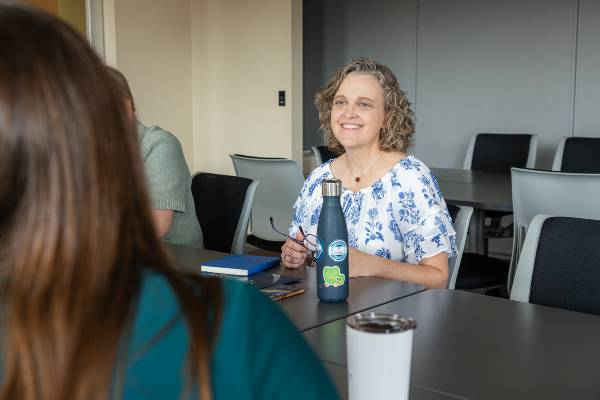
For Flatt in her new role as NWTC provost, integration is her North Star. “We have all these departments and structures – student finance and resource navigators, advanced manufacturing and skilled trades, and corporate training – and ‘Students just call it college,’” Flatt says. “How do we work better together, building new and better structures together, examining data together, impacting students together so that we are building something that works for all students?”
Flatt’s career as an educator in Northeast Wisconsin spans more than 26 years. Prior to her current role, she developed and taught courses, onboarded part-time instructors, developed programming for first-year college students, and led NWTC’s Student Affairs Division.
Growing up in a family of educators, Flatt knew at an early age that she wanted to be a teacher – that is, after a short-lived phase in which she wanted to be a jockey.
“Around age 8 I realized I still hadn’t been on a horse, and I was pretty scared of horses up close; so I set that aside,” she recalls with a smile.
So Flatt set her sights on becoming a college English teacher. Along the way, she had doubts about whether she was good enough or smart enough to fulfill that dream.
“Self-doubt had a huge formative influence on who I am as an educator,” Flatt says. “A big part of my work has focused on recognizing that most people struggle with confidence, all of us at one time or another. So I have always focused on not just teaching content but also teaching confidence.”
In addition to teaching English, Flatt has taught Spanish – “one of the best unexpected twists” in her life.
“After earning my doctorate in English, I found a job to apply for that said, ‘Teach English and, if possible, teach communication/speech or Spanish.’ I realized I could leverage my second bachelor’s and graduate coursework in Spanish, so I applied, got the job, and quickly discovered that teaching intro and intermediate Spanish was one of my favorite things to do,” Flatt says. “Spanish in my life is a great reminder and example that we can and should have great plans – and we should stay open to new opportunities we never imagined!”
Now, as NWTC provost, Flatt enjoys getting to “connect lots of dots.” She sees many opportunities to align projects and major initiatives so the College’s Academic Affairs and Student Affairs divisions can work more efficiently and effectively, helping more students reach post-graduation success.
While being a provost wasn’t part of Flatt’s original career plan, she has realized the strong connection between teaching and her current role.
“I dreamed of making a difference, of helping people realize their dreams of a satisfying career that sustains them and their families,” Flatt says. “That’s still at the core of what gets me up every day.”
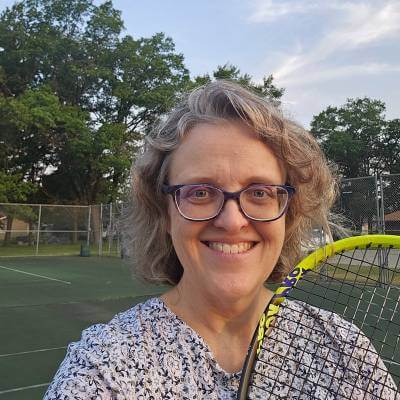
What does Flatt enjoy doing outside of work? “So many things!” she says. Flatt resides with her family in the Marinette area, in a Victorian home that she and her husband are restoring. They have become seasoned wallpaper and ceiling paper hangers, using authentic reproduction wallpaper they paste by hand.
Family and hobbies also overlap in her life in other ways. She likes playing tennis with her older son, who is a college student and tennis instructor. She also enjoys game nights with both of her sons, including her younger son, who is entering his senior year of high school.
An avid reader, Flatt loves mysteries, historical fiction, science fiction, and nonfiction. She also enjoys writing to shape and record her thoughts. She plays piano and organ at her church and loves playing grand postludes loudly to celebrate or quiet reflective pieces she’s known for decades. Going for walks, cooking, and traveling are other favorite pastimes for Flatt.
After graduating from NWTC in 2024, Karlie DeGrave went on to earn her bachelor's from Lakeland University: “Transferring gave me the opportunity to open more doors."
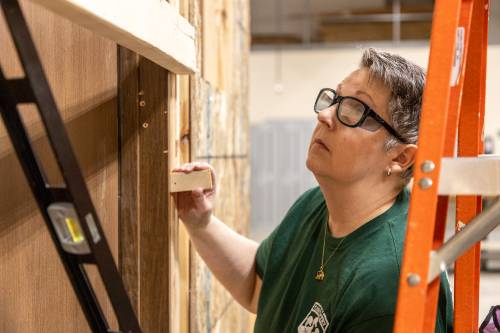
After 30 years in manufacturing, Theresa Schindler enrolled in NWTC's Carpentry program. One of her key drivers is putting homeownership within reach for more people.
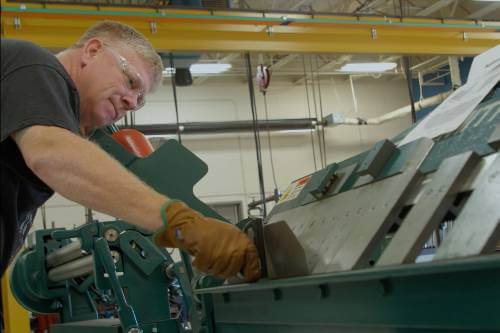
Tim Pigott, a Navy veteran with 23 years of active-duty service, recently graduated from NWTC’s Metal Fabrication program after taking his knowledge to a level he never thought possible.